



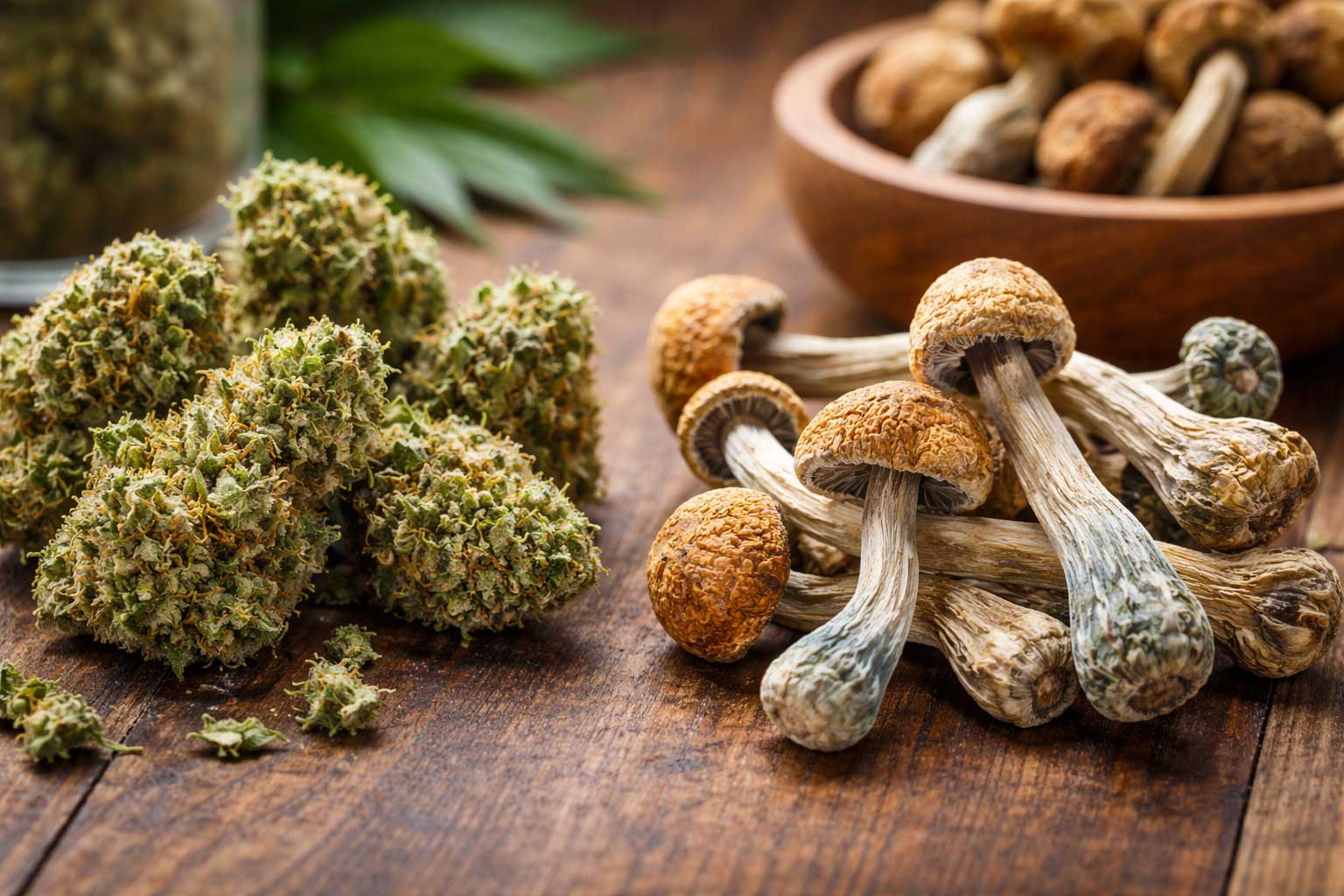
Decarboxylation is one of the most important chemical processes in cannabis science — yet it is often misunderstood. It explains why raw cannabis does not produce intoxicating effects and why heat plays a crucial role in activating certain compounds.
But what about mushrooms? Do they require the same process? Here’s a clear, science-based breakdown of how decarboxylation works in cannabis versus psilocybin-containing mushrooms.
What Is Decarboxylation?
Decarboxylation is a chemical reaction that removes a carboxyl group (–COOH) from a molecule through heat. When this group is removed, the compound changes structure and becomes pharmacologically active.
In simple terms:
Heat converts inactive acidic compounds into their active forms.
During this reaction:
- A carbon dioxide (CO₂) molecule is released
- The compound becomes more bioavailable
- Psychoactive or therapeutic effects can activate
Decarboxylation in Cannabis
Why Raw Cannabis Doesn’t Get You High
Fresh cannabis does not naturally contain high amounts of THC. Instead, it primarily contains:
- THCA (Tetrahydrocannabinolic Acid)
- CBDA (Cannabidiolic Acid)
These are the acidic precursor forms of cannabinoids. They are not intoxicating in their raw state.
When heat is applied — through smoking, vaping, or baking — the following transformation occurs:
- THCA → THC
- CBDA → CBD
This is decarboxylation.
How It Happens
The process occurs at temperatures between approximately:
- 220–240°F (105–115°C)
- 30–45 minutes (when preparing edibles)
Smoking and vaporizing naturally trigger instant decarboxylation because of high combustion temperatures.
Why It Matters for Edibles
Without decarboxylation:
- THC remains in THCA form
- Psychoactive effects are minimal or absent
That’s why cannabis must be heated before being infused into butter or oil for edible products.
Decarboxylation in Psilocybin Mushrooms
Do Mushrooms Require Heat Activation?
Unlike cannabis, psilocybin mushrooms do not require heat decarboxylation before use.
The primary compound in psychedelic mushrooms is:
- Psilocybin
After ingestion, the human body converts psilocybin into:
- Psilocin
Psilocin is the compound responsible for psychoactive effects.
What’s the Difference?
In mushrooms, conversion occurs primarily through enzymatic processes in the digestive system and liver — not from heat.
In fact, excessive heat may:
- Degrade psilocybin
- Reduce potency
- Destroy sensitive compounds
Drying mushrooms at controlled temperatures is common for preservation, but high cooking temperatures can lower active content.
Key Differences Between Cannabis and Mushrooms
| Factor | Cannabis | Psilocybin Mushrooms |
|---|---|---|
| Primary raw compound | THCA | Psilocybin |
| Active compound | THC | Psilocin |
| Requires heat to activate? | Yes | No |
| Activation location | External heat | Inside the body |
| High heat effect | Activates THC | May reduce potency |
The Chemistry Behind the Reaction
The carboxyl group (–COOH) is an acidic functional group attached to many organic molecules.
When heat is applied:
- The bond breaks
- Carbon dioxide (CO₂) is released
- The molecular structure becomes neutral and more bioactive
In cannabis, this structural change is necessary for THC to bind efficiently to CB1 receptors in the brain.
In mushrooms, psilocybin converts metabolically into psilocin through dephosphorylation rather than heat-driven decarboxylation.
Why This Matters for Consumers and Researchers
Understanding decarboxylation helps explain:
- Why raw cannabis juicing does not produce intoxication
- Why edibles must be heated before infusion
- Why overheating mushrooms may reduce potency
- How molecular chemistry impacts real-world effects
As cannabis legalization expands and psychedelic research grows globally, clarity around these processes becomes increasingly important for both safety and scientific literacy.
Frequently Asked Questions (FAQ)
What happens if you eat raw cannabis?
Raw cannabis contains THCA, not active THC. Without heating, psychoactive effects are minimal.
Do mushrooms need to be decarboxylated like cannabis?
No. Psilocybin converts into psilocin naturally inside the body after ingestion, without requiring heat.
Can heat destroy mushroom potency?
Yes. High temperatures may degrade psilocybin and reduce effectiveness.
Why does smoking cannabis work instantly?
Because combustion temperatures instantly trigger decarboxylation, converting THCA into THC.
Is decarboxylation only about psychoactivity?
No. It also impacts medicinal compounds like CBD, which must be converted from CBDA to become fully active.